
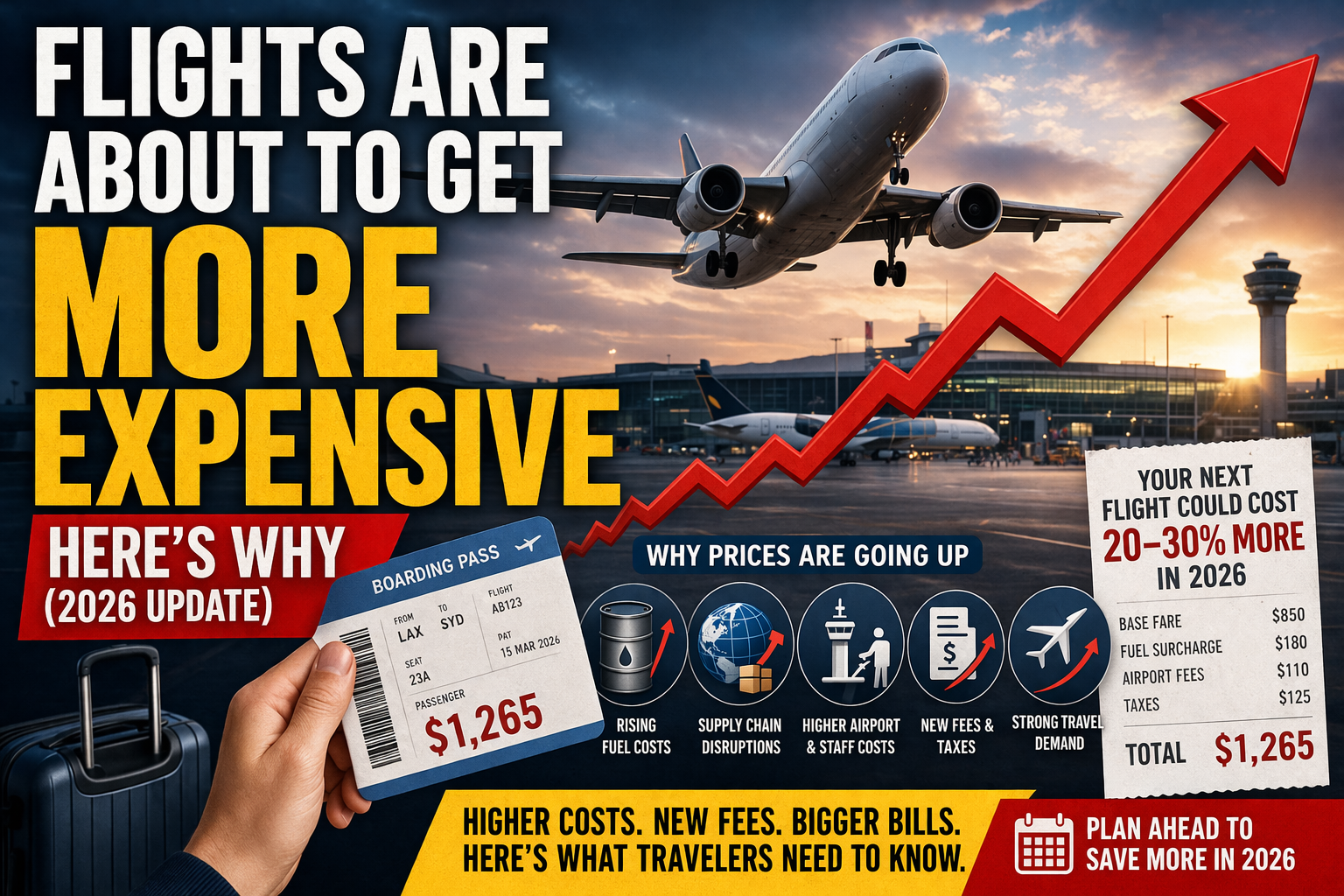
Flight prices are rising again – and this time, it’s not a short-term spike.
Behind the scenes, a combination of fuel shocks, airline capacity cuts, airspace closures, and relentless travel demand is quietly – and quickly – pushing airfares higher in 2026. If you haven’t booked your next trip yet, what you pay tomorrow may be significantly more than what you’d pay today.
🚨 What’s Happening Right Now
The aviation industry is in the middle of one of its most turbulent pricing environments in years.
Ticket prices for the most recent week of available data, beginning March 9, were up 24 per cent from the same week in 2025, according to OAG, a global travel data provider.
That’s not a rounding error. That’s a structural shift – driven by a cascade of factors that show no sign of reversing quickly.
Airfare was already rising before the latest global disruptions began. After falling 3.4 percent in 2025, domestic airline fares rose 6 percent in January and 7.1 percent in February, according to data from the Bureau of Labor Statistics.
The trend was already moving in the wrong direction for travelers. Then came the fuel crisis, and everything accelerated.
A recent analysis of U.S. airline ticket prices by Deutsche Bank analysts found that average domestic airfares for travelers booking flights this month have climbed by between 15 and 124 percent. The cost of a flight on discount carrier Spirit Airlines for late-March jumped from $86 to $193. The average fare for transcontinental flights surged over 100 percent, while flight prices to the Caribbean, Florida, and transatlantic destinations have also risen significantly.
Travelers in the US, Europe, and Australia are all feeling the pressure. This is a global aviation story, and it is developing fast.
Fuel Costs Are Surging – And That’s the Main Driver
To understand why your next flight costs more, you need to understand one simple equation: the price of a plane ticket tracks the price of jet fuel more closely than almost any other variable.
Second to labor, an airline’s largest cost is jet fuel. Dependent upon crude oil prices, it accounts for 20 to 30 percent of an airline’s total expenses, according to aviation industry experts.
When fuel spikes, airlines face an immediate choice: absorb the loss, cut flights, raise fares, or all three. In 2026, they’re doing all three simultaneously.
Since before the current disruptions began, the price of jet fuel in the U.S. has surged by 95 percent – from $2.50 per gallon on February 27 to $4.88 on April 2, according to the Argus U.S. Jet Fuel Index, published by Airlines for America. That puts the price per barrel at nearly $205.
To put that in concrete terms: on February 27, the cost to fill the fuel tanks of a single Boeing 737-800 was approximately $17,000. Less than a week later, on March 5, that same fill-up cost more than $27,000.
That’s the cost of fuelling one aircraft for one flight. Multiply that across thousands of daily departures, and the financial pressure on airlines becomes clear.
United Airlines CEO Scott Kirby stated in a March 20 note: “Jet fuel prices have more than doubled in the last three weeks. If prices stayed at this level, it would mean an extra $11 billion in annual expense just for jet fuel.”
Making matters worse, most U.S. airlines no longer hedge fuel costs – that is, lock in prices using futures and other financial instruments. Southwest Airlines was one of the last holdouts, and it exited that strategy in 2025. That leaves U.S. carriers far more exposed to price swings than at any point in recent history.
✈️ Airlines Are Flying Less – And That Pushes Prices Higher
Less supply plus steady demand equals higher prices. It’s Economics 101 – and it’s playing out across airline scheduling right now.
United Airlines became the first major U.S. carrier to scale back its schedule, with CEO Scott Kirby announcing the airline would start “tactically pruning flying that’s temporarily unprofitable in the face of high oil prices” — cutting approximately 5 percent of planned routes during the second and third quarters of 2026. Cuts are focused on red-eye and midweek services.
United isn’t alone. JetBlue announced it was raising baggage fees, citing “rising operating costs.” Analysts say other carriers are likely to follow.
Deutsche Bank warned that sustained elevated price levels for jet fuel could pose an “existential threat” to the airline industry, noting that carriers often cut routes and ground planes when fuel costs become excessive.
Fewer flights mean fewer seats. Fewer seats means competition for the remaining inventory drives prices up – especially on popular routes and during peak travel windows.
💰 The Hidden Factor: Airline Pricing Algorithms
Here’s something most travelers don’t fully understand – and airlines certainly don’t advertise.
Modern airfare pricing isn’t set by a human in a back office. It’s driven by sophisticated, AI-powered dynamic pricing systems that monitor dozens of variables in real time: current demand on a route, how many seats remain, how far out you’re booking, what competing airlines are charging, and increasingly, what you’ve been searching for.
These systems are designed to extract the maximum price the market will bear at any given moment. When fuel costs spike and fewer seats are available, the algorithms respond instantly. They don’t wait. They don’t gradually ease prices up. They reprice continuously, and they skew aggressively upward when supply tightens.
Scott Keyes, founder of flight deal company Going, put it plainly: “Airlines never met a higher fare they didn’t want.”
While airlines cannot collectively agree to raise prices, as that would violate anti-collusion laws, nearly all carriers are dealing with the same market forces simultaneously. One carrier cites rising costs to raise fares. Others quietly follow, each citing the same external pressures.
The practical effect for travelers: the price you see right now is almost certainly lower than the price you’ll see next week.
🌍 Global Instability Is Adding Costs to Every Flight
The fuel crisis doesn’t exist in a vacuum. It is directly connected to geopolitical disruption, and that disruption is reshaping flight routes and operational costs worldwide.
Commercial airspace across much of the Middle East remains closed, forcing airlines to reroute flights around conflict zones. Longer routes mean more flight time, more crew hours, and critically, more fuel burned.
The Strait of Hormuz, a critical corridor for global oil transport, has been significantly disrupted, affecting jet fuel supply chains worldwide. As overseas carriers seek alternative supply sources, the cost for a globally traded commodity like jet fuel rises across the board. “It shocks the entire mechanism,” said Jaime Brito, executive director at Oil Price Information Service consultancy.
The ripple effects are being felt from Sydney to Stockholm:
- Australian airline Qantas has added fuel charges to ticket prices
- Scandinavian Airlines (SAS) introduced a “temporary fuel-related price adjustment”
- Cathay Pacific roughly doubled its fuel surcharges on tickets from March 18
- Air France-KLM announced round-trip tickets would increase by €50 due to jet fuel costs
This is not a U.S.-only problem. It is a global aviation reset – and travelers everywhere are paying the price.
📈 Demand Is Surging – Even as Prices Rise
Logic might suggest that as prices climb, fewer people fly. In 2026, that logic is being tested.
Air travel demand has remained steady, with January and February ticket sales at or near records. Several U.S. airline executives confirmed to industry media that travel demand remains strong despite rising costs.
The phenomenon of “experience-first” spending – where consumers prioritize travel over material goods – has fundamentally changed how price-sensitive the travel market is. People who budgeted for a summer trip are still booking that summer trip, even if it costs significantly more than planned.
That sustained demand gives airlines cover. When seats fill regardless of price, carriers have little incentive to hold fares down.
United CEO Scott Kirby confirmed as much: “The environment is conducive for passing along fare increases.”
In other words: the airline industry has the demand conditions it needs to raise prices — and it intends to.
⚠️ What Happens Next
This is the question every traveler needs answered – and the answer isn’t encouraging.
While some officials have described the current fuel price spike as temporary, aviation industry leaders are preparing for oil prices to remain elevated into late 2027. United Airlines CEO Scott Kirby stated that airfares could rise up to 20 percent to offset oil-related expenses. American Airlines confirmed a $400 million impact on its first-quarter 2026 expenses from rising fuel costs alone.
Average airfares for travel between late April and mid-May have already increased 10 to 15 percent versus prices before the latest disruptions started. Summer travel fares are up approximately 18 percent versus a year ago.
Several consequences are increasingly likely in the months ahead:
Fewer routes. As airlines cut unprofitable flights, smaller and regional routes face disproportionate exposure. Travelers relying on direct services to secondary cities may find those services reduced or eliminated.
Budget airlines under pressure. Low-cost carriers operate on thinner margins and are more vulnerable to sustained fuel price increases than major legacy airlines. Expect budget carriers to add fees, cut routes, or both.
Long-haul travel becomes a premium product. International and long-haul flights burn the most fuel. As costs rise, the gap between economy and business class pricing is likely to widen – and economy fares on long-haul routes may no longer feel affordable in the traditional sense.
Helen McDermott, director of global forecasting at Tourism Economics, confirmed: “Higher operational costs will ultimately feed through to higher airfares.”
The trajectory is clear. The only question is how steep it gets.
💡 How Travelers Can Still Save
The situation is difficult – but not hopeless. There are still strategic ways to reduce what you pay for flights in 2026.
Book now, not later. This is the clearest advice from industry experts right now. Supply chain expert Rob Handfield from North Carolina State University advised: “If you’re buying for three or four months down the road, I would lock it in and buy now.” Prices are expected to keep climbing in the near term – and there is no sign of a reversal.
Avoid basic economy fares. As long as you don’t book basic economy, you can typically change your flight without a fee if prices drop later. Scott Keyes from Going explains: “If you book a $500 summer flight today, and two weeks from now the price drops to $350, you can call up the airline and get the $150 difference back as a credit. Heads you win; tails the airlines lose.”
Fly in August, not June or July. August fares have historically been lower than June and July, as more Americans concentrate their summer trips in early summer due to earlier school return dates. This pattern is expected to hold in 2026 – making late August one of the better value windows still available.
Use points and miles strategically. Airfares rise faster in cash terms than in points and miles pricing. Redeeming travel rewards during a fare surge can deliver significantly better value than paying cash — particularly on award flights, where cancellations typically return all miles with no penalty.
Be flexible on airports. Flying into or out of secondary airports – rather than major hubs – can still yield meaningful savings, especially on routes where budget carriers operate without full fuel surcharges.
Travel in off-peak windows. Midweek flights, particularly Tuesday and Wednesday departures, continue to carry lower fares than weekend travel. With airlines cutting red-eye and off-peak routes first, booking those windows now – before they disappear – may lock in lower prices on services that are becoming scarcer.
🔚 The Bottom Line: This Is Not Temporary
It’s tempting to frame rising airfares as a short-term crisis that will resolve itself once tensions ease. The data suggests otherwise.
The forces pushing ticket prices higher – fuel volatility, airline hedging strategies that leave carriers fully exposed to price swings, AI-driven pricing systems designed to capture maximum revenue, persistent travel demand, and ongoing global instability – are not variables that will simply disappear when conditions change overseas.
Airlines are structurally different businesses than they were five years ago. They are leaner, less hedged, more dependent on dynamic pricing, and increasingly oriented toward premium travelers who are less price-sensitive. That model works well for airline balance sheets – and poorly for budget-conscious travelers.
Adapting to this new reality means treating flight booking less like a last-minute impulse and more like a financial decision. Book early. Stay flexible. Use rewards. Know your airports.
The era of reliably cheap airfare – already fading before 2026 – may be receding further in the rearview mirror. The skies are still open. Getting there just costs more now – and understanding why is the first step to making smarter decisions about when and how to fly.
Looking for ways to keep travel costs down? Read our guides on finding cheap flights, understanding private jet costs vs. commercial travel, and the best travel hacks for 2026.
